

BSK
Well-Known Member
I'm seeing a very odd pattern from the mature bucks I have on my place this October. First, it is true that deer are generally "crepuscular," meaning their peak movements are in low-light conditions, such as at dawn and dusk. The first graph below is data from14 years of trail-camera data, displaying the hour of the day when I've gotten buck events on camera (an "event" is a buck triggering the camera. Doesn't matter how long he stands there or how many pictures are taken of him, it is still just one "event"). The times at the bottom of the graph are that hour's data. For example, the data bar for 5:00 AM is all of the events for 5:00 AM to 5:59 AM. And the actual measurement is that hour's data as a percentage of all the hours combined. [Also of note, for scientific purposes, all of my data is collected in Central Standard Time, even though October is still Daylight Time]. Notice events for bucks of all ages, how their peak movement times are right at dawn and dusk. The morning peak movement is the 6 AM hour (6:00 - 6:59 AM CST) - the first full hour of daylight - and the afternoon peak is in the 5 PM hour, right at dusk.
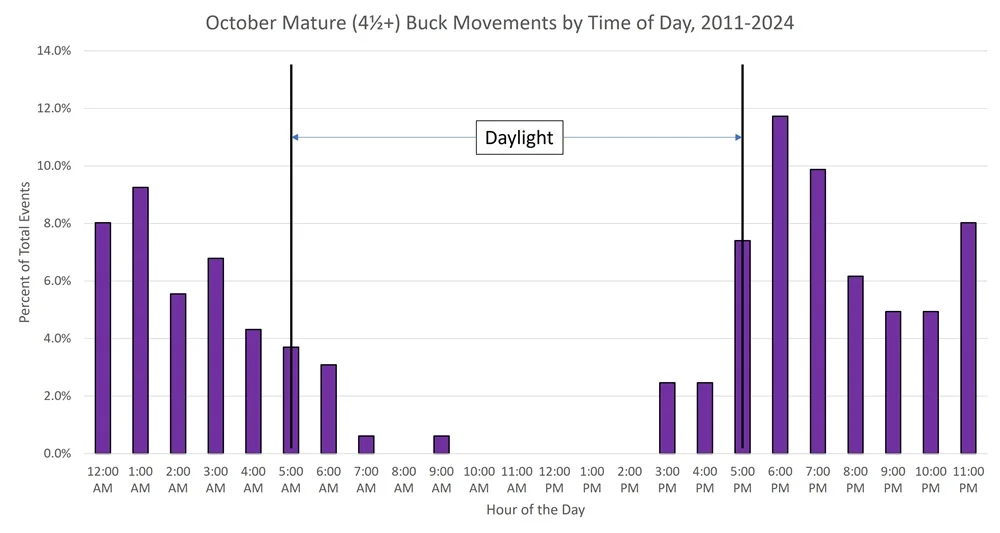
However, this crepuscular movement patterns normally does not hold true for mature bucks (4 1/2+). Even though these deer are NOT being hunted in October, they are still very nocturnal. The second graph below is the same data as the first graph, but only for mature bucks. Notice how mature buck events in October do NOT peak at dawn and dusk. These age bucks' activities peak the first full hour of darkness (the 6 PM hour), and then again from midnight to 1:59 AM. VERY nocturnal.
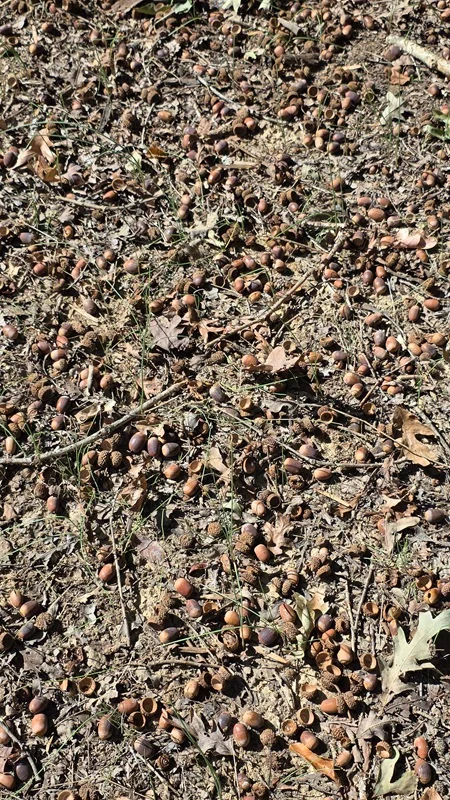
Yet here is the odd behavior I'm seeing this October (third graph). The mature bucks this year in October are displaying a massive peak in movement during the last hour of daylight (5 PM hour). This is VERY unusual for October. And when reviewing what the mature bucks are up to at this time, they are just standing around or temporarily feeding in food plots waiting on does to step out. As soon as a doe group enters the food plots, the bucks go right after them. This is more what I would expect to see in an acorn failure year, as all of the deer need to feed in the plots. In a good acorn year, more activity is usually picked up on trail-cam back along the oak-heavy ridgelines in the mornings, not in the food plots in the evenings. We have a big acorn crop this year, but the deer sure aren't acting like we do.
Anyone else seeing this pattern?
However, this crepuscular movement patterns normally does not hold true for mature bucks (4 1/2+). Even though these deer are NOT being hunted in October, they are still very nocturnal. The second graph below is the same data as the first graph, but only for mature bucks. Notice how mature buck events in October do NOT peak at dawn and dusk. These age bucks' activities peak the first full hour of darkness (the 6 PM hour), and then again from midnight to 1:59 AM. VERY nocturnal.
Yet here is the odd behavior I'm seeing this October (third graph). The mature bucks this year in October are displaying a massive peak in movement during the last hour of daylight (5 PM hour). This is VERY unusual for October. And when reviewing what the mature bucks are up to at this time, they are just standing around or temporarily feeding in food plots waiting on does to step out. As soon as a doe group enters the food plots, the bucks go right after them. This is more what I would expect to see in an acorn failure year, as all of the deer need to feed in the plots. In a good acorn year, more activity is usually picked up on trail-cam back along the oak-heavy ridgelines in the mornings, not in the food plots in the evenings. We have a big acorn crop this year, but the deer sure aren't acting like we do.
Anyone else seeing this pattern?



![Pampers Sensitive Baby Wipes, Clinically Proven, Fragrance Free, Unscented, Water Based, Hypoallergenic, Multi-Use, Hand Wipes 336 Wipes Total (6X Flip-Top Packs) [Packaging May Vary]](https://m.media-amazon.com/images/I/41KLBHu9CAL._SL500_.jpg)