
Some interesting buck "time of day" data

Tennessee Deer Sporting & Deer Hunting Community Forum

Help Support TNDeer | Tennessee Deer:

BSK

Well-Known Member
Joined
Mar 11, 1999
Messages
92,534
City & State/Province
Nashville, TN
Been working on this project for awhile, so I thought I would post some of the data.

I started looking at my trail-cam data and wondering how the times of the buck photographs would compare over a 24 hour day, especially during the peak of the hunting season. Hoped I would learn something that would make me a better hunter.

Considering hunting was my focus, I started entering all of the times bucks have been photographed during the peak of our hunting time - November (peak rut month) and December (post-rut month). I classify a buck-on-camera "event" at the time he first shows up on camera. If a buck hangs around for 10 or 20 pictures, it's still classified as just one "event." Each time a buck showed up in front of any camera on the property, the date and time of that event were recorded. Also the camera location and type of set-up were recorded, as well as breaking down the bucks behavior into a few key groupings. So far, I've just analyzed the events by the hours of the day. Each hour's data is represented as the percent of events in that hour compared to the total number of events in that data set. This "normalizes" the data between years, allowing equal comparison, as some years had more events than others.

For this project, a wide variety of camera set-ups were used. The two most common were cameras pointed into food plots and across scrapes. But any feature that concentrates deer movement is included, such as holes and low-spots in fences, terrain and habitat bottlenecks, old log-skidder roadbeds, deer trails, saddles in ridges, secondary point and main ridge junctions, etc.

So with six years of trail-camera data entered, encompassing 1,564 total events for November and December, here's some analyses.

Below is the graph of camera events of just older bucks (those 2 1/2 years old or older). Each vertical bar represents the percent of total camera events that fell within that hour (1:00 PM to 1:59 PM, 2:00 PM to 2:59 PM, etc.) The two vertical black lines on the bar graph depict the approximate times of daylight and dark (in my area, around 6 AM and 5 PM, respectively for those months). Notice how activity at night stays consistently high, and how activity peaks right around first light and dark, but then falls precipitously to the low point of the 1 o'clock PM hour (1:00-1:59 PM). This is the hour with the lowest percentage of older buck events appearing on camera. What I found really interesting is that the hourly peaks really do occur at dawn and dusk, just like the species classification suggested (they are called "diurnally crepuscular," meaning they move in daylight at twilight). I was also surprised by how late into the morning older bucks are moving, with still some solid movement all the way until the end of the 10 AM hour (10:00-10:59 AM). This will vindicate what TheLBLman has been saying for years. ;) A really odd result I never expected was the low number of buck events in the last hour of darkness before morning daylight (5:00 AM hour). This pattern was very consistent from year to year. I have no idea why this occurs.
 

Attachments

  • TimeOlder.jpg
    TimeOlder.jpg
    51.3 KB
Last edited:
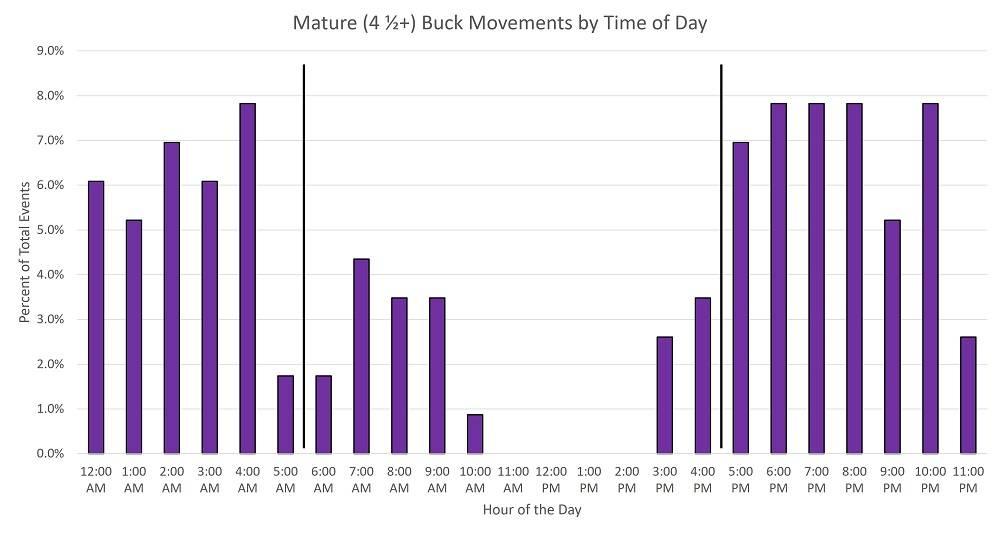
And now for the data for just mature bucks (those 4 1/2 years old or older). I was not at all surprised at how much more nocturnal the buck event data is for only mature bucks versus all bucks 2 1/2 and older. But I was not expecting NO mature buck events in 6 years (again, just November and December) for the period 11:00 AM to 2:59 PM. NONE. In addition, if I had guessed before I saw the data graphed, I would have speculated almost all daylight pictures of mature bucks would have occurred during only the first and last hour of daylight. But that is not the case. Mature buck movement has been pretty solid through the morning hours, out until at least the end of the 9:00 AM hour (out to 9:59 AM). And once again, that weird low point at first light, from 5:00 AM to 6:59 AM.
 

Attachments

  • TimeMature.jpg
    TimeMature.jpg
    47.9 KB
Last edited:
That is very interesting. My dad always told me I was going in too early getting up and out by 4:30-5:00am. He said bucks aren't busy until 7:30-8:00am. I always ignored him, thinking I knew better. I suppose I am due a heaping plate of crow! Seems he was right.
 
Very interesting. Can't say I'm all that surprised on what the data shows for the daylight hours. That is almost identical to what we see, so this just shows validation. We don't see much movement with older deer after 9:00. Typically I am down and headed back by 9:30. Also, that hour before light, I always found it odd that more deer aren't spooked when going in. It just always seems dead. I like that though because that's when we are headed in. For the evenings, 3:15 till dark. That's what my notes show. Thanks for sharing!
 
Interesting......on a cool November morning 7am to 9am has always been "prime time" on our place...even one stand in particular 7:10am to 7:30am on a cool morning your going to see deer....I will say that one thing that surprises me is with all the cameras you run in 6 years you have never once captured a single 4½+ year old buck between 11am and 3pm in the month of November... don't get me wrong....my cameras are not going crazy taking pictures mid day....but during the first two weeks of November I've seen enough (and killed a couple) mature bucks to keep me on stand. Other than that...agree with JC Deerman...this data validates our experiences.....it also validates the thread from last year where someone ask "morning or evening - when have you killed more deer?"....if memory is correct mornings won hands down....thanks for sharing your data.... Very interesting.
 
As an Amazon Associate we earn from qualifying purchases. Product prices and availability are accurate as of the date/time indicated and are subject to change.
Looking back at my top 10 bucks over the years.... 6 we're killed in the morning...2 in late afternoon and 2 midday....11:15am and 1:10pm....both midday bucks were alone...both were in November...both were cruising into thick bedding areas....and no cameras were set up in the specific area where either buck was killed.... hasn't happened often over the years...but enough to keep my attention....and in November anything is possible.
 
A really odd result I never expected was the low number of buck events in the last hour of darkness before morning daylight (5:00 AM hour). This pattern was very consistent from year to year. I have no idea why this occurs.

I actually have solid evidence, not just a theory about this one.

Not only do deer move a lot at night, but they also bed a lot at night.
They feed a while, then they bed a while, somewhat like they do during the day.

What I've observed is that deer are most often simply bedded pre-dawn, having spend much of the night roaming & feeding. But right at pre-dawn, as first light is either breaking or about to, they "sense" it's getting light, and then begin their traveling transition to better bedding or better sanctuary areas to spend the day.

Most people would be surprised at just how much time deer spend bedded out in a field under the cover of darkness. Soon as it's barely getting light, they're getting up & leaving. But often during deer season, it's hunter activity that causes this, often even sooner.

For those who try to be totally ready on their stands BEFORE light, have you ever noticed how often you observe bedded deer when you're walking in, and so long as you're not walking directly toward them, they will often not flush, even as you pass them under 40 yds?
 
For those who try to be totally ready on their stands BEFORE light, have you ever noticed how often you observe bedded deer when you're walking in, and so long as you're not walking directly toward them, they will often not flush, even as you pass them under 40 yds?
I've had this experience several times. Because we hunt from ladder stands, we have "cateye" reflective tacks going to each stand. Several times I've been following the string of cateyes and though, "why did I put of pair of cateyes 40 yards off the trail, and low to the ground?" Not cateyes. Deer bedded. And rarely do they get up, as long as I'm not walking directly towards them.
 
I was not expecting NO mature buck events in 6 years (again, just November and December) for the period 11:00 AM to 2:59 PM. NONE.

I have a partial answer to this one.

It's not that there isn't a fair amount of mature buck movement between 11:00 & 12:30 pm, but more a case of your cams not getting this pics.

I have learned this more over years of all-day stand sit than by my trail cams.

During the rut, and from late morning until @ 12:30 pm (central time zone for me), the mature bucks have a much greater tendency to travel more in a run than a walk, and more often seem to just take off by sight, or using the wind, more than they normally would be using trail & terrain features.

I suspect this often begins with their "stalking" heavy cover areas where female deer may be in hiding. They flush a doe, she runs, they either hear or see her, and take off STRAIGHT towards the sight or the sound. I've often referred to this as their "cutting a diagonal" since they totally go off the grid of following trails or easier terrain features.

You would almost never accidently have a trail cam pick up on this simply because their routes would rarely take them in front of the spots we place them. And at least in times past, when it did happen, I would find a "blank" pic, meaning just a pic of nothing, as the deer went by faster than my older trail cams could trigger & get a good pic.

Such mid-day "runs" often result in a doe running out into the middle of a field, and the buck often goes right out there, too. Typically "herding" her back into cover where he may feel more secure. This has happened to me many times over the years @ 12N, and often not resulted in my getting a shot because I couldn't get a good one.

That said, even though I've seen this happen between 1:00 pm & 2:00 pm, the "deadest" time of day is typically @ 1:00 pm by my observations.
 
Interesting......on a cool November morning 7am to 9am has always been "prime time" on our place...even one stand in particular 7:10am to 7:30am on a cool morning your going to see deer....I will say that one thing that surprises me is with all the cameras you run in 6 years you have never once captured a single 4½+ year old buck between 11am and 3pm in the month of November... don't get me wrong....my cameras are not going crazy taking pictures mid day....but during the first two weeks of November I've seen enough (and killed a couple) mature bucks to keep me on stand. Other than that...agree with JC Deerman...this data validates our experiences.....it also validates the thread from last year where someone ask "morning or evening - when have you killed more deer?"....if memory is correct mornings won hands down....thanks for sharing your data.... Very interesting.
On my place, I've always called the 7-8 AM timeframe the "Golden Hour." That's when we kill the most older bucks.
 
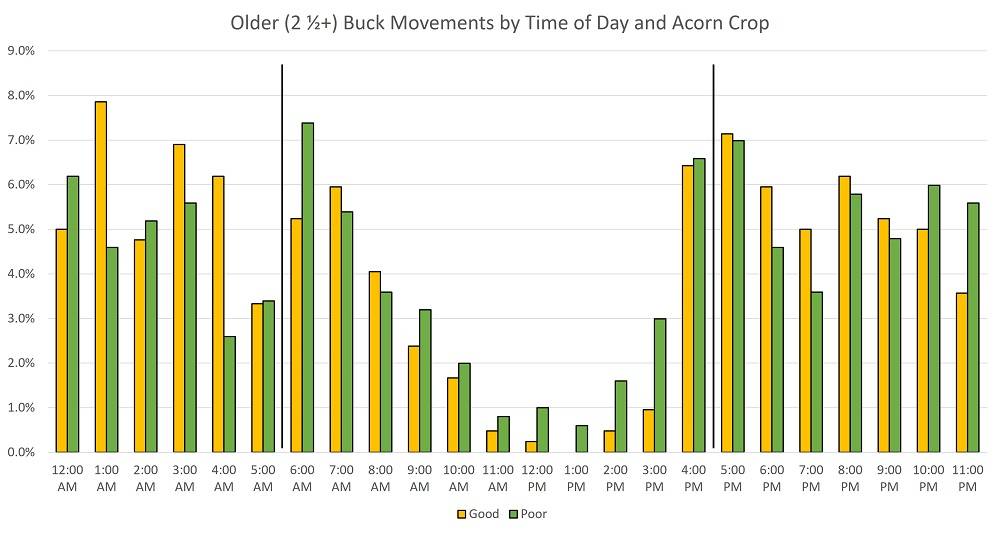
OK, here's the same timeframe of data, but broken down by years with a good acorn crop versus a poor acorn crop. Just by coincidence, 3 of the 6 years in the data set were very good acorn years, and 3 very poor acorn years. I've always suspected daylight movement of older bucks is greater in a poor acorn year, as deer have to travel more and farther to find food in a poor acorn year, exposing themselves to hunters (and cameras) more frequently.

Below is the older buck camera events for November and December for good versus poor acorn years. The orange bars are the good acorn years and the green poor acorn years. Other than the 7 and 8 AM hours, poor acorn years consistently have higher event percentages across the daylight hours. I'm really surprised by the VERY high movement in a poor acorn year for the 6 AM hour.
 

Attachments

  • TimeOlderAcorns.jpg
    TimeOlderAcorns.jpg
    57.4 KB
And here is the buck events data for only mature bucks in good versus poor acorn years. I'm not surprised by the higher event percentages in a good acorn year for the 7 and 8 AM hours. That's when I've killed the majority of my mature bucks. HOWEVER, I'm fascinated by the unusual peak in mature buck percentages for the 3 PM hour in a poor acorn year. Of the mature bucks I've killed in the afternoon, almost all have fallen just after 3 PM during a poor acorn year. I'm also really interested in that late morning mature buck data for a poor acorn year. That 9 and 10 AM data really has me thinking I've been missing the boat in a poor acorn year.
 

Attachments

  • TimeMatureAcorns.jpg
    TimeMatureAcorns.jpg
    48 KB
Last edited:
Likely you would have more events of mature buck movement between 11-2 inside of bedding areas. For obvious reasons, your cameras were outside of these areas. But, if you were going to hunt during these times, being on the edge of these areas, might be more productive.

I've killed a buck or two chasing does in these bedding areas and had the doe break out into the timber with the buck following during these times.

Thanks for sharing this valuable information BSK.
 
Good stuff Bryan.
Thanks for sharing.
I agree.
There will always be "outliers" for the mid day movers but generally speaking spot on!

In 338 bow kills and 35 gun kills my most repetitive kill time is 10 AM EST (after time change 9 AM) and 7/6 PM.

One of my largest bucks was an outlier at noon in a bamboo thicket on a doe in rut.

I rarely walk to my stand in dark. Almost always it's breaking day.

Also I rarely ever leave before 11 EST before the time changes. 10 or so after it drops back.

I generally get on stand about 4 EST.
 
HOWEVER, I'm fascinated by the unusual peak in mature buck percentages for the 3 PM hour in a poor acorn year. Of the mature bucks I've killed in the afternoon, almost all have fallen just after 3 PM during a poor acorn year.

Odd you mention the 3pm hr. I have one particular stand in hill & holler country that sits on a skinny finger ridge dropping down from a military shelf that overlooks a saddle with an oak grove in the bowl of it. For the last 3yrs in a row on Oct. 30th I have watched big bucks get out of bed from that point and walk down that finger during the 3pm hour. Different buck each year and one was within bow range and I killed him. The spot is so consistent within time & date that it feels like cheating. It's uncanny. There's just something about that spot on that day at that time. I don't know the relation to acorn production other than there are nuts there every year, even in bad years. There are a couple dozen mature white oaks within a 3 acre area and it is the busiest spot on the property for does while those oaks are dropping.
 
My guess is all these times are regional?
I would almost guarantee they are not only regional, but probably unique to THAT location. I have no doubt if this data were collected somewhere else, the numbers would come out a bit differently. I never cease to be amazed how rapidly deer adapt to localized conditions. Change the conditions (move the deer to a different property/habitat), and they will change their behavior.
 
Likely you would have more events of mature buck movement between 11-2 inside of bedding areas. For obvious reasons, your cameras were outside of these areas. But, if you were going to hunt during these times, being on the edge of these areas, might be more productive.

I've killed a buck or two chasing does in these bedding areas and had the doe break out into the timber with the buck following during these times.

Thanks for sharing this valuable information BSK.
No doubt I would find some different results if cameras were deep in thick cover. But as you hinted at, we don't enter or place cameras in our thick sanctuary cover.

And you are absolutely correct about hunting the edges of thick cover. As I discussed in the thread on "what have we learned from all the data we collect," I had discovered where 100% of our 3 1/2 year-old buck sightings had occurred from stands positioned within 100 yards of thick cover. That taught me to intentionally place stands along the edges of thick cover. I can't count the number of times I've gotten glimpses of older to mature bucks working just inside the edges, or watched a mature buck chasing a doe in and out of that cover. With the mature buck I killed this last year, the stand was positioned with my back to the cover, not more than 15 yards behind me. I caught the buck coming out of the cover about 50 yards to my right.
 
During the rut, I believe mature bucks move around much more during late morning & mid-day than the data suggests, and most hunters think.

The main reason more hunters aren't aware is because so few are actually out hunting after mid-morning. The main reason the trail cams don't catch more of it is multi-fold.
 
I would almost guarantee they are not only regional, but probably unique to THAT location. I have no doubt if this data were collected somewhere else, the numbers would come out a bit differently. I never cease to be amazed how rapidly deer adapt to localized conditions. Change the conditions (move the deer to a different property/habitat), and they will change their behavior.
I'm willing to bet you'll likely see more daylight movement, particularly later in the morning and earlier in the afternoon, now that you've vastly improved your habitat with all your logging. That has been what we have seen undoubtedly.
 
Another thing to remember is the hunting pressure variable. I've been inputting only the November and December data because I'm trying to learn things that will make us more successful hunters, and those two months are when we do all of our hunting. And we put a LOT of pressure on the property during November, to the tune of about 200-250 hours of treestand time during that month alone. What would the data look like if the property WASN'T being hunted during the rut month? I bet quite different!

Eventually I will get around to entering the data for the pre-rut month of October. Being pre-rut, and especially be UNHUNTED during that month, will probably display from very different results.
 
There are different "types" of buck movement during the rut, and for older bucks not currently with a doe, I believe most those older bucks will actually spend more time "moving" during the day than bedding.

Break this buck movement (among bucks not tending a doe) down into two broad categories:

1) Stalking doe bedding areas
2) Significant linear distance moves between doe bedding areas.

We miss observing most these mid-day movements mainly because of cam placement and as hunters, our physically not being out there hunting (and/or not hunting within or close enough to heavier cover).

We hunters also miss seeing a lot because we've not paid enough attention to detail when it comes to the noises we make coming & going, and often "over-hunt" our hunting spots. This often causes deer to alter where they more habitually spend their time during midday, having learned our coming & going routes. This is part of why I habitually move my mobile stands @ 1 pm most days, and avoid hunting a particular tree or spot more than one evening & morning in a 2-week period. My moves from one spot to another are commonly @ 75 yds.
 
I'm willing to bet you'll likely see more daylight movement, particularly later in the morning and earlier in the afternoon, now that you've vastly improved your habitat with all your logging. That has been what we have seen undoubtedly.
Funny you mention that. In the past, our "habitat management" consisted mainly of cutting small patches of timber every 5 years or so. The total acreage cut was never great, only 20-25 acres at a time, scattered in 3-5 acre patches. That's only 5% of the total property with each cut. Yet even with those small changes, we would see significant changes in daylight deer activity rising and falling on a cycle that matched our timbering schedule. Now with the massive single year change of cutting 20% of the property, I'm excited to see what results. Last year was our first year of hunting after the big timber cut, and I definitely saw behaviors and movement patterns I've never seen before, even though it was a bumper acorn year. I can't imagine how different things will be in a poor acorn year, like it looks like it will be for us this coming year.
 
One thing I've discussed with BSK before, but not on this thread, is how wind habitually effects older buck movement during the rut. I absolutely love having lots of those young beech trees purposefully left in the more mature hardwoods bordering sanctuary cover.

On those "big frost" November mornings when the air is still, there is something magical that often occurs @ mid-morning (about the time BSK has left his stand) as the wind begins picking up, just enough to kinda gently, but steadily "rattle" those beech leaves. They actually can sound very much like a deer walking.

I believe bedded bucks often mistake the sound of rattling beech leaves for walking deer, then often leave bedding areas to investigate what they heard.

Also, I believe ANY periodically heard sound, breaking silence on a rather calm day, can stimulate older buck movement. I believe they've learned that other sounds camouflage their walking sounds, and feel more secure in making a move when such sounds present. Wind is one of the best and most common, but an airplane going over often seems to stimulate deer getting up and walking.

But back to those beech trees.
The are both a blessing & a curse. They can greatly limit vision, and prevent one from hearing a walking deer. Many hunters want to have them removed, as do the foresters. I prefer leaving a few around good stand sites, believing some are more blessing than curse.
 

Latest posts

Back
Top