
You are using an out of date browser. It may not display this or other websites correctly.
You should upgrade or use an alternative browser.
You should upgrade or use an alternative browser.
Anybody seen bucks chasing yet?
- Thread starter jwp1964
- Start date




Yes indeed. We've seen chasing for the last four days. Does are not ready and are trying to avoid the bucks.

Took my mom for a drive yesterday and we saw 3 separate bucks chasing does in the afternoon in the rain here in Wilson county. Made me wish I was hunting!

Yep. I have been seeing the small ones chasing.

Trapper John
Well-Known Member
Harassment has definitely commenced in Decatur County. The women are having none of it at the moment.






As an Amazon Associate we earn from qualifying purchases. Product prices and availability are accurate as of the date/time indicated and are subject to change.
MickThompson
Well-Known Member
The ones that were starting are splattered on the highway
deerhunter10
Well-Known Member
Seen 3 little buck this evening pestering does. Does wanted nothing to do with it.
Boll Weevil
Well-Known Member
Pic evidence of harassment now underway in SW TN as of yesterday. Just now starting.

Yes, watched a mature buck chase 2 does last week, about 30 minutes north of Jackson.
Savage
Well-Known Member
I killed a good buck last week that pushed a doe over me at 9:00
killingtime 41
Well-Known Member
Seen 2 young bucks hit on interstate 81 several miles apart this morning first time this year so something is going on. Greene county
BSK
Well-Known Member
Chasing like crazy in my area, and I suspect a little breeding during the false rut around the 15th. Got video sequences of a couple of mature bucks after one doe in particular. Suspect she was actually in estrus.
Bucks are living in the food plots waiting for does to enter. Every doe who does, gets chased.
Bucks are living in the food plots waiting for does to enter. Every doe who does, gets chased.
Derek
Well-Known Member
I drive I-840 every day. When dead deer start showing up after being hit by a car, it tells me it has started. It started about a week ago. That is a little earlier than it has the last few years. I've also seen some live ones sparring and chasing does on cell cams.
Trapper John
Well-Known Member
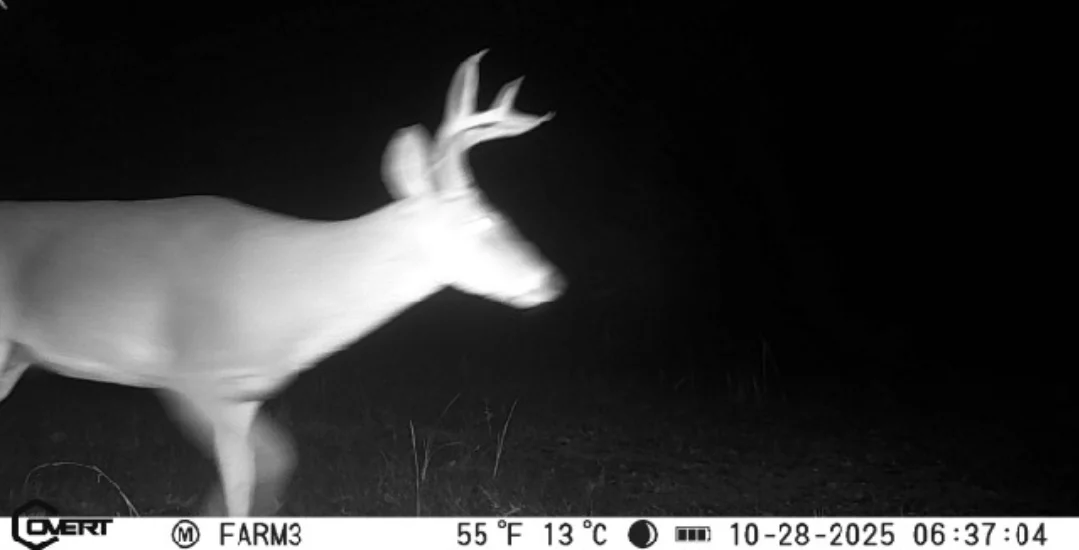
Ten minutes apart. You can almost hear the theme music from Jaws in the pre-dawn light...

Last edited:
I sat for a couple hours after work yesterday. Had a nice 8 point come through nose to the ground on a mission. Tried to grunt and rattle to turn him, and he ignored me.
Over the weekend drove to Arkansas to hunt, and almost hit a massive 12 point crossing the main rd half a mile from where I was headed to hunt. Had to stop while he walked slowly across. When the mature bucks start ignoring cars, and crossing roads I start feeling the rut myself.
Over the weekend drove to Arkansas to hunt, and almost hit a massive 12 point crossing the main rd half a mile from where I was headed to hunt. Had to stop while he walked slowly across. When the mature bucks start ignoring cars, and crossing roads I start feeling the rut myself.

I get to see a lot of deer activity at my work everyday in Montgomery County. I watched two different mature bucks dog does hard this week. I've seen a lot of sparring between young bucks. And I'm seeing deer in areas where I dont normally see them. They're breaking up and beginning to roam around more. Love this time of year.

Good thread. From the reports I am reading and hearing from middle and west TN, "the bucks" seem to be ahead of last year by a fair amount. With that said, I did not witness much of any rutting activity last year while on stand in SW TN. It seems this year is shaping up to be better, all things considered. Hopefully we can get some below normal daytime temps to encourage daytime activity/sightings.
WTNBowHunter
Well-Known Member
I haven't seen any chasing. It's typical for younger bucks to pester does at this time but our rut in SW TN is at the end of November through the first week of December. I usually see mature bucks beginning to cruise around the middle of November though.
Since mast production was mentioned, and was minimal last year for our neck of the woods. I wonder how much, if any, mast products plays a role toward mature buck efforts in marking territories and being mobile outside of their summer ranges. I know there are lots of variables but just curious if mast production (or food availability) has any impact, anecdotally?
Since mast production was mentioned, and was minimal last year for our neck of the woods. I wonder how much, if any, mast products plays a role toward mature buck efforts in marking territories and being mobile outside of their summer ranges. I know there are lots of variables but just curious if mast production (or food availability) has any impact, anecdotally?
I have not seen any chasing but then again there might not be anything around to do the chasing or be chased.

I have not witnessed any chasing yet. I did watch does avoid bucks last weekend on juvy. Also, fields had scrapes with buck pee in them already. The buck my girl killed was already stinking.
BSK
Well-Known Member
It really comes down to "excess energy to burn." In a good acorn year, bucks have more excess energy to burn. For this reason, they rub and scrape more in a good acorn year. We normally see hundreds of rubs on our property, but last year with the severe drought and acorn failure, we counted exactly 6 rubs on 500 acres. And that was with a similar older buck population to good acorn years where rubs are everywhere.I haven't seen any chasing. It's typical for younger bucks to pester does at this time but our rut in SW TN is at the end of November through the first week of December. I usually see mature bucks beginning to cruise around the middle of November though.
Since mast production was mentioned, and was minimal last year for our neck of the woods. I wonder how much, if any, mast products plays a role toward mature buck efforts in marking territories and being mobile outside of their summer ranges. I know there are lots of variables but just curious if mast production (or food availability) has any impact, anecdotally?

Lincoln Co Archer
Well-Known Member
Last Wednesday, the 22nd, was pretty incredible for movement on our place. Had 3 different mature bucks that were pestering does that morning.
BSK
Well-Known Member

deerhunter10
Well-Known Member
Last year was weird. It seemed like we had little to no prerut then the rut hit for 7 to 10 days then just stopped. Besides here and there. Around Thanksgiving the deer put their head down and just ate til the end of the season.Good thread. From the reports I am reading and hearing from middle and west TN, "the bucks" seem to be ahead of last year by a fair amount. With that said, I did not witness much of any rutting activity last year while on stand in SW TN. It seems this year is shaping up to be better, all things considered. Hopefully we can get some below normal daytime temps to encourage daytime activity/sightings.
megalomaniac
Well-Known Member
We jad a big spike in mature buck activity 1 w ago, now its almost nonexistent and completely solitary.
Like BSK said, young bucks are parking in food plots and chasing out every doe that tries to come in and feed.
Unfortunately, its looking like I have net lost mature bucks compared to new mature bucks shifting in... thats super frustrating for someone like me who completely focuses on maximizing habitat quality for whitetails. Most years its a wash and I pick up as many new range shifters as I lose.
Like BSK said, young bucks are parking in food plots and chasing out every doe that tries to come in and feed.
Unfortunately, its looking like I have net lost mature bucks compared to new mature bucks shifting in... thats super frustrating for someone like me who completely focuses on maximizing habitat quality for whitetails. Most years its a wash and I pick up as many new range shifters as I lose.
This is what I have been seeing.
We jad a big spike in mature buck activity 1 w ago, now its almost nonexistent and completely solitary.
Like BSK said, young bucks are parking in food plots and chasing out every doe that tries to come in and feed.
Unfortunately, its looking like I have net lost mature bucks compared to new mature bucks shifting in... thats super frustrating for someone like me who completely focuses on maximizing habitat quality for whitetails. Most years its a wash and I pick up as many new range shifters as I lose.
I wouldn't worry yet. I'm not seeing much shift yet either. And yes last week was hot for mature buck activity compared to now, but I'm hoping it's the calm before the storm.
megalomaniac
Well-Known Member
WTNBowHunter
Well-Known Member
that makes a lot of sense! thanks BSK!It really comes down to "excess energy to burn." In a good acorn year, bucks have more excess energy to burn. For this reason, they rub and scrape more in a good acorn year. We normally see hundreds of rubs on our property, but last year with the severe drought and acorn failure, we counted exactly 6 rubs on 500 acres. And that was with a similar older buck population to good acorn years where rubs are everywhere.


